Sunday, June 07, 2009

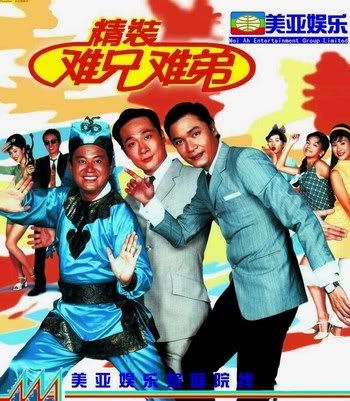
[HK Movie]Those were the Days (1997)


王晶电影之恶搞,我这一代人,真的是从小看到大的。不过,这部以恶搞之名向香港早期粤语片致敬的喜剧,我真的是第一次看,王晶再度使用“不是女人”为名作编剧,打造这部从头到尾kuso至极的香港电影史诗片。

1937上海沦陷后,上海的电影资源逐渐转向香港,1940-1960间,香港的粤语电影和国语电影并济,国语片主要由绍氏兄弟出品作品类型主要有浪漫音乐剧和史实片,例如李翰祥导演的《江山美人》;而粤语片的制作成本相对较低,出名的有武侠片《黄飞鸿系列》以及一些描写现代生活的戏剧(melodrama),还常常会加入一些粤剧唱词,也被称为粤语长片。而这部《精装难兄难弟》就以香港电影人独有的态度来怀念那个粤语片的辉煌时代。我印象里另一部向粤语长片致敬的是刘镇伟导演的《92黑玫瑰对黑玫瑰》,也非常经典。

这部片讲的是获得法国金牛奖的大导演王晶卫对于粤语电影出言不逊,于是被粤语片导演楚活游(大导演楚原本人扮演)活活地从电视里伸出手把他拉到30年前的 1967年,让他拍出一部让人称赞的粤语片才放他回1997。于是,王大导演在片场就遇到了那些日后成为粤语片大牌的演员们,和他们一起混阿混,终于混出了几部作品但却不成功,在临死之前被一个胖胖小男孩王星(暗指王晶)夸奖,终于回到1997。全片的主题是,几乎每个人物原型都是响当当的电影人,但是剧情却90%是虚构,10%是基于事实的恶搞,相当KUSO。

暗指的演员:
王晶卫(剧情)--王家卫(真人)--黄子华(演员)
谢源 -- 谢贤 -- 吴镇宇
李奇 -- 吕奇 -- 罗嘉良
牛达华 -- 曹达华 -- -- 陈百祥
绍芳芳 -- 萧芳芳 -- -- 舒淇
程宝珠 -- 陈宝珠 -- 张可颐
秀秋姐 -- 于素秋 -- 陈法蓉
家燕 -- 薛家燕 -- 陈阎行

所暗指的这些明星,当年都是超级大牌。现在我们比较熟悉的,有谢霆锋的老爸谢贤,现在72岁了还保养的那么好就可推算当年的模样(电影里说他将来的儿子叫谢柠檬XD);今年香港电影金像奖终身成就奖获得者萧芳芳(女人四十、还有方世玉的搞怪老妈);薛家燕人称好姨,也常在TVB出现;陈宝珠,出身粤剧世家,这两年也有在香港登台表演。比较不熟的就有武打明星曹达华,其实他后期都还有在港片中客串,贴张照片就知道了;而吕奇也是个传奇明星,早年也走小生路线,和陈宝珠是荧幕情侣,后期转型投资拍摄三级片,息影后在台经商,《92黑玫瑰对黑玫瑰》中梁家辉扮演的那个警察吕奇也是暗指他,有点娘的气质外加很独特的嗓音。这几位演员都演得很好,尤其是吴镇宇,真的非常神似。

就像所有穿越时空的故事一样,王晶卫也要证明自己真的来自1997年,他的方法之一就是盗版VCD,方法之二是提出“建设性建议”,于是粤语片开始流行吊钢丝,怪兽出现,奶油小生等等(灵感每次都来自于惨痛经历),他自己也拍摄了《飞佬正传》、《黄飞鸿之春光乍泄》、《东蛇西鹿》,可惜还是没人看得懂。影片重现了很多粤语片的场景,就像我们现在看一部电影,里面如果穿插了大量周星驰电影的片段,也会马上被认出来理解为恶搞笑点。最后当王晶卫遇到小王晶的时候,小王晶对王晶卫说,我很喜欢你的电影,但是王晶卫对小王晶说,不要,你多去蹲蹲厕所,“屎尿屁”将会成为你电影的精髓(王晶果然从不忌讳低俗两字,只要卖座)。影片最后还附赠《差佬故事》、《金猪肉叶》、《古惑佬》短片,部部爆笑。

除了恶搞好笑之外,这部戏浓缩了香港电影的两个时代,一个就是当年的粤语片时代,孕育了80-90年代中港片的黄金时期,一个就是90年代到,无厘头小市民的香港商业片从鼎盛逐渐走下坡,也算是一代电影人对上一代电影人的致敬。也许再过10年,就有一部kuso周星驰、刘德华的电影出现了,算是80后、90后对童年电影的致敬。

Wednesday, June 03, 2009

June Fourth, After 20 Years

June 4th,2009, in China, Internet becomes Intranet. A bunch of mainstream western media (HK media, too) which are identified as "anti-Chinese" were once again blocked by GFW, including newbie Twitter, and Microsoft's new search engine, BING.COM (poor guy, only one-day old in Chinese market), flicker, etc. Another bunch of Chinese websites voluntarily closed for maintenance between June 3rd and June 5th (to avoid unnecessary conflicts), including Chinese twitter, Fanfou, Douban, etc. What is left on the Intranet then? Probably only CNN's interview with pop stat Edison Chan about his photos .

The over-reaction is just the fear of what happened 20 years ago.

I was
less than 5-year-old in 1989 when the protest happened, and during my entire school education and family education, no one has ever told me anything about the protest. I learned the information from the Internet (no wonder they fear). I really would use June Fourth rather than Tiananmen Square Movement, or Tiananmen Square Massacre in memory of the students or the soldiers died that time. It is really important to recognize the date it happened, it is 1989, June 4th, the year which is 70-year anniversary of The May Fourth Movement for Science and Democracy, 1919 (the first student movement in Modern China history); the date exactly one month later. This is a tradition of young generation to pursue democracy with their true passion and idealism, that my generation will never ever have.

In a less
developed society, the history is written by the ruler; but in a open and democratic society, the citizen should at least know what happened, and they will have their own justification. We know better that history is not black and white, so what the government is hiding.

This is a music video in memory of the 20-year
anniversary of the June Fourth Movement of 1989 from Hong Kong. Hong Kong will hold an annual candlelight vigil on this day at Victoria Park for June Fourth. This song is by a Hong Kong rock band, Beyond, the name is War of Resistance for 20 years, perfectly matched.

Monday, June 01, 2009

[Reading] Who Controls the Internet (2006)

Though written by two law experts, this book on Internet governance and related civil rights, copyright, and cyber criminal issues is written in a humor and light style. Especially the first few chapters, which introduce the early history of the Internet development, contrasting to the current situation, is like a adventure of Utopianists fight with state machine. The early experts' forecast of the Internet is full of idealism, but still inspiring, especially the story of the root authority, Jon Postel , which is referred as "the god of the Internet" in this book. Culturally, Internet definitely brings the grass-roots spirit to the world, even in the Central-controlled country; yet, realistically, it is a tool, a commercialized tool, initially for national defense purpose, it is impossible to avoid the impact of the commercialization and government interference.

The book is divided into three chapters, first part is about the early history of Internet, and the second part includes governments' involvement in the past years while the third part discusses the future and the global law. I think there should be an update of the book: when talking about the MGM v
Grokster case, the book only traced back to 2004, when the court still recognizes the technological innovation over contributory infringement of Grokster, so the book quoted "the death of copyright"(pp112). Actually, Grokster eventually lost the case in 2005, Gorkster is ruled as liable for infringement.

In the government control chapter, the authors devote a chapter for China, which makes me have to say something. The China chapter makes two point, the stringent control and the
CPC uses Internet as a tool to raise nationalism. I totally agree with the two facts.

Looking at how the mainstream media online treat the 512 Si
Chuan earthquake has demonstrated both points. Right after 2008, May12, the earthquake, the portal sites, such as SINA , SOHU, gave tons of information about the survivors, the casualty, the rescue team, which united the whole country by the efficient information flow. Now, a year later , we still dont know exactly how many students were buried during the earthquake and why those school buildings so easily crashed. Any negative news one 512 earthquake is sensitive information that is blocked by the GFW and by self-censorship of media. Independent blogger, Ai WeiWei, who conducted personal survey of the earthquake, has been 'invited' to talk to the police (Gong An), and his blog on SINA has been wiped out. Moreover, citizen journalist in that area (Wen Chuan, SiChuan Provence) were more or less targeted by the police (according to Ai weiwei's blog). With the coming 20-year anniversary of June 4th, no need to bother the GFW, the internal control of service providers and mainstream websites are sufficient, for instance, Baidu's university bulletin boards no longer allow users to post articles, you can just read but not comment; and some popular websites among youngsters also have deleted more information than past months by the end of May. And,Blogger has been completely blocked by GFW in May, 2009.

The authors have expressed deep concern of the censorship and the effective
control of Chinese government. I am just wondering how effective it really could be. Though being censored again and again, we now are able to hear Yang Jia's case or Deng Yujiao's case that we would otherwise never know and never pay attention to discuss. The really terrifying thing is not that they are blocking and censoring things, but they are threatening your safety and family safety in a lot cases since no legislation to protect citizen in these situations till now. The well-know government control of China's Internet actually mirrors the fragile legislation and litigation system in China.